Showing posts with label Architecture. Show all posts

Monday, 20 May 2019

Of Mardin's monasteries, wine and stone houses


From Gaziantep it was onwards to Mardin. Mardin was high on my visit list as it is at the confluence of several religious and cultural inflection points. Among others, Mardin is a cocktail of Arab, Armenian, Syrian Orthodox Christian and Turkish influences.

The narrow stone streets and houses
of Mardin's old city (Photo: Imran Ahmed)
Mardin is so close to the Iraqi and Syrian borders that kite flying may easily turn into a crossborder activity if one is not careful! Arabic is widely spoken in the city. Historic Armenian, Greek and Syrian Orthodox monasteries and churches dot the region.

Inside one of the many historic
churches found across Mardin (Photo: Imran Ahmed)
Like many cities in Turkey, Mardin has an old and a new section. 

For travelers the stone houses and narrow lanes of the old city hold more charm than the new, high rise buildings and supermarkets of Yenisehir or New City. Walking around the old city there is always a chance of running into an ancient place of worship or monument, e.g. Mor Behnam Kırklar Kilisesi, Zinciriye Medresesi or the Mardin Museum. Not to mention the Protestant Church, Ulu Cami (Grand Mosque) or the Mardin Evleri.

The courtyard of the historic
Syrian Orthodox Church in Mardin (Photo: Imran Ahmed)
While in Mardin, there are some worthwhile day trips to consider, e.g. to nearby monasteries – functioning monasteries with entrance fees and guided tours! 

There is also the historic town of Hassankeyf - which may be underwater by the time you read this post. Hassankeyf is expected to be submerged by June 2019 as a large dam has been built close by. Once the dam's reservoir is filled then the existing town will be underwater. It's worth noting some historic monuments and the town's entire population have been moved to the 'New' Hassankeyf located not far from the 'original' town.

The 'new' Hassankeyf town on the
Tigris River in the Batman province near Mardin (Photo: Imran Ahmed)
Wine is another attraction in Mardin. Remember the monasteries mentioned above? Well, these monks and their friends ferment wine from local grapes in large quantities. It's reasonably priced (or cheap if you're buying wine in a highly taxed environment like Singapore) and easy drinking. The wine is readily available in shops dotted on the main street of the old city.

Grapes from the Midyat valley produces decent
wine which is easily available across Mardin city (Photo: Imran Ahmed)
Mardin is about architecture and history. It's about soap (yes, there's a lot of good locally produced soap around) and wine. It's about narrow lanes and stone houses. It's about keeping alive Christian monuments and practices in a country which is 99.8% Muslim (according to Turkish government sources). For travelers heading to Turkey's east, Mardin is a necessary stop.
______________________________________________________

Imran is a Singapore based Tour Guide with a special interest in arts and history. Imran has lived and worked in several countries during his career as an international banker. He enjoys traveling, especially by train, as a way to feed his curiosity about the world and nurture his interest in photography. Presently, Imran is spending ten weeks (March – May 2019) in Turkey exploring the country. He is available on twitter (@grandmoofti); Instagram(@imranahmedsg) and can be contacted at imran.ahmed.sg@gmail.com.

Thursday, 9 May 2019

Adana: much more than a kebab


From Konya it was onward to Adana. Adana is a nice sized city of 1.75 million persons located 35 kilometers inland from the Mediterranean coast. The Seyhan River flows through the city.

It's not difficult to reach Adana. Intercity public buses ply regularly to Adana from Konya. There is also a Turkish Railways (TCDD) train – the Toros Express – which travels between the two cities daily in a six hour rail journey.

Photo: Imran Ahmed
As I always find train travel more comfortable than buses choosing the Toros Express was a no-brainer - despite knowing TCDD's old fashioned diesel electric locomotive trains are not fanous for their punctuality (arriving two hours late may be considered 'on time!').

A Turkish Railways diesel electric locomotive stands at the head
of the Toros Express train at Konya station (Photo: Imran Ahmed)
The Toros Express train reached Adana after dark and we took a taxi to the hotel. Sitting in the taxi observing the city on the drive to the hotel I felt a sense of panic and dread. The hotel seemed in the middle of nowhere surrounded only by commercial warehouses! After check-in all I could see from our hotel window were a few trees and total darkness!

Things are always clearer when the sun ishines, i.e. during daylight. So it was with Adana. It turned out the empty space across the hotel was a park and beyond the park flowed the Seyhan River. In other words, the hotel's location was perfect!

Adana was a great place to rest and destress. Sure, there are several sights worth exploring, such as the grand Sabanci Merkez Cami or Sabanci Central Mosque but at its heart, Adana is for rest and recreation not for visiting six different attractions daily over a weekend.

The Sabanci Merkezi Cami (Photo: Imran Ahmed)
Nonetheless, it's hard to miss the Sabanci Mosque – nor should one miss it. The mosque is built on the banks of the Seyhan River and it is huge! It can accommodate 28,500 faithful for prayers, has six minarets with the tallest being 99 meters. Those numbers may not mean much to many but trust me the mosque is large. In fact, at the time of writing it is the largest mosque in Turkey (though soon to be surpassed by the official opening of a new mosque in Istanbul).

The banks of the Seyhan River (Photo: Imran Ahmed)
Though there are sights other than the mosque, the recommended plan for Adana is walk around the bazaar, eat some Adana kebab and, most importantly, stroll along the promenade by the Seyhan River – past the Sabanci Merkez Mosque – stop for a Turkish cay (tea) and simply soak in the environment. In today's information filled, wired society the soothing sounds of Turkey's longest river flowing toward the Mediterranean Sea is enough to add Adana to any Turkey travel itinerary.


Imran is a Singapore based Tour Guide with a special interest in arts and history. Imran has lived and worked in several countries during his career as an international banker. He enjoys traveling, especially by train, as a way to feed his curiosity about the world and nurture his interest in photography. Presently, Imran is spending ten weeks (March – May 2019) in Turkey exploring the country. He is available on twitter (@grandmoofti); Instagram(@imranahmedsg) and can be contacted at imran.ahmed.sg@gmail.com.

Monday, 15 April 2019

Eskisehir, Turkey: travel hub or hidden gem?


From Bursa our next destination was Konya. However, exploring Turkey at leisure meant the long direct journey to Konya was conveniently broken at Eskisehir. Eskisehir is on the main high speed train route to Konya from Istanbul so it made sense to spend a few days in Eskisehir then take the YHT bullet train to Konya.

Eskisehir did not disappoint; though it helped that our hotel was clean and had strong WiFi versus the dump of a hotel in Bursa (no names shall be mentioned). Yes, after spending several days in a run down hotel it was nice to be in a modern hotel with good infrastructure!

The Porsuk Cayi River runs through Eskisehir and is lines with bars, cafes and restaurants.
(Photo: Imran Ahmed)
Eskisehir or literally old (eski) town (sehir) is ironically mostly a new town. With two major universities in town – Anadolou University and Eskisehir Osmangazi University – Eskisehir is a university town.

But it is much more than simply a university town. It is, after all, a city of almost one million people. For a city of that population, Esiksehir is remarkably compact.

Like many ancient cities - Eskisehir's history can be traced to at least the Byzantine period - it is located on the banks of a river. The Porsuk Cayi River runs through Eskisehir's center. Both sides of the river are lined with cafes, bars and restaurants making it pleasant to stroll by the river. There were even gondolas and river cruises for tourists operating on the river!

One of the many bridges across the river. (Photo: Imran Ahmed)
The highlight of the Eskisehir trip was a walk to Odunpazari District. Odunpazari is an amalgamation of fresh produce street markets, hotels, cafes, restaurants and traditional Turkish style coffee houses. The bazaar is a place to wander, sip coffee and browse souvenirs while taking in the traditional Turkish architecture of the area's houses.

Another unexpected though pleasant surprise was coming across an Aviation Museum in the vicinity of our hotel. However, one should not be too surprised given the city's links to aviation. There is a large Turkish Air Force base on the outskirts of the city. (Fighter planes streaked through Eskisehir skies routinely.) Additionally, the city houses much of Turkey's burgeoning airplane parts manufacturing and maintenance industry.

Eskisehir's Aviation Museum is a great place to see the evolution of the Turkish Air Force and many of it has planes flown from past to present. (Photo: Imran Ahmed)
Eskisehir is a pleasant town with its own subtle charm. Being a university town gives the city a particular character. Following a short stay, Eskisehir came across as a great place - perhaps providing a glimpse into modern (Kemalist) Turkish society outside of the country's main centers of Istanbul and Ankara. If you have a few days to spare and, especially if you like fighter planes, then Eskisehir's your city!


Imran is a Singapore based Tour Guide with a special interest in arts and history. Imran has lived and worked in several countries during his career as an international banker. He enjoys traveling, especially by train, as a way to feed his curiosity about the world and nurture his interest in photography. Presently, Imran is spending ten weeks (March – May 2019) in Turkey exploring the country. He is available on twitter (@grandmoofti); Instagram(@imranahmedsg) and can be contacted at imran.ahmed.sg@gmail.com.

Saturday, 13 April 2019

Mosques more beautiful than Istanbul's Blue Mosque – maybe?


Istanbul's Ottoman Turkish monuments and architecture are well known. Istanbul buildings like the Blue Mosque (Sultan Ahmet Mosque) and the Sulemaniye Mosque, Topkapi Palace, even the Hagia Sofia are visited by millions each year. Less well known are the Seljuk styled mosques dotted across the pre-Constantinople capital city of Bursa.

Bursa's gold bazaar is located in an old han or travelers hotel complex (photo: Imran Ahmed)
Bursa can be reached in approximately two hours by car from Istanbul or by a ferry to the nearby port of Mudanya in about the same time. A note of caution about the ferry services from Istanbul's Eminonu pier to Mudanya: they are subject to weather conditions.

The day of our departure all ferry services to Bursa were canceled due to rough seas. We ended up taking the bus from Istanbul's Harem bus terminal to Bursa's Otogari Terminal. Bursa's bus terminal is out of the historic city center so be prepared for another trip before reaching your hotel. Taxis and local Metro buses are easily available at the terminal.

Let's get back to Bursa. Like many places in Turkey, Bursa traces its history back to Greek and Roman times. There are even some Roman artefacts on display at the British Museum in London, Britain. (I wonder if these pieces were gifted or simply appropriated when the treasure was located in the early 20th century?)

Bursa was captured by the Ottoman Turks in 1326. Subsequently, the city became the Ottoman capital. It was during the Ottoman period that Bursa gained its nickname of 'Green Bursa.' The city was lined with gardens and parks and its importance as a fruit growing region was enhanced. Architecturally, the Ottomans also left behind several mosques and monuments which are a must see.

While traces of Bursa's ancient history are found mostly in museums, the period from the fourteenth century onward is plainly visible for any traveler moving around the city, e.g. the Ulu Cami or Grand Mosque which dominates an entire section of Bursa.

Men pray inside the main prayer hall of the Ulu Cami or Grand Mosque (photo: Imran Ahmed)
The Grand Mosque was completed in 1399 with some unique features. Notably, it contains a fountain inside the mosque giving the mosque a beautiful tranquil feel. Moreover, the mosque has twenty domes. Apparently, Sultan Beyazit I (1389- 1402) pledged to build twenty mosques after winning the Battle of Nicopolis against a combined European Crusaders force. Ultimately, Sultan Beyazit I (aka the 'Thunderbolt') decided to fulfill his pledge by building one mosque with twenty domes!

Then there is the Yesil Cami or Green Mosque and its adjacent Yesil Turbe (Green Mausoleum). The Green Mosque was completed in 1422. It is named after the green-blue tiles which line its interior. The mosque has living quarters for the Sultan (and his harem) in case he decided to grace the area for an overnight stay.


A fountain in the courtyard of the Yesil Cami or Green Mosque (photo: Imran Ahmed)
Although Bursa's main sites can be seen on a day trip from Istanbul, there is much to be said for a longer stay in this city – especially if you wish to take in the nearby Mount Ulugdag, Turkey's premier ski resort. There's also the seaside town of Mudanya – 25 kilometers from Bursa and the landing point of the ferry from Istanbul – which is known for its fish restaurants and nightlife (disclosure: I have not visited Mudanya … yet). Travelers wishing to get beyond Istanbul and the Sutan Ahmet area will find Bursa worthwhile choice.


Imran is a Singapore based Tour Guide with a special interest in arts and history. Imran has lived and worked in several countries during his career as an international banker. He enjoys traveling, especially by train, as a way to feed his curiosity about the world and nurture his interest in photography. Presently, Imran is spending ten weeks (March – May 2019) in Turkey exploring the country. He is available on twitter (@grandmoofti); Instagram(@imranahmedsg) and can be contacted at imran.ahmed.sg@gmail.com.

Monday, 9 April 2018

Dream Cities: Seven Urban Ideas That Shaped the World by Wade Graham – a book review


After reading this book, it seems amazing to try and understand modern human history without any familiarity with cities, urbanization and the development of the metropolis. In many ways, urbanization has been the driving force behind human progress over the last few centuries, since the Industrial Revolution.

There is no doubt much of contemporary human culture and social tradition is intertwined with the urban area. Cities have developed their own culture and lifestyle and much of that is based on the living arrangement within each city, i.e. the unique architectural blend of each city. For example, Singapore will not be Singapore without its HDB (Housing Development Board) estates. From its ‘coffee shop’ culture to its ‘New Town Centers’ the HDB estate is the cornerstone of a certain unique Singaporean lifestyle.


In order to help readers make sense of different styles, Wade Graham organizes his book by theme and in a loose chronological sense. Each chapter covers a basic architectural idea, e.g. Castles, Monuments, Malls, etc. For a non-architecture type like me, it appears these categories – at least to some extent – represent the thought of the author and may be controversial to others. Undoubtedly, some architectural historians will dispute the categories and propagate their own different framework for the development of urban architectural styles.

The author’s deep knowledge of recent architectural designs comes out clearly in the book. Different architects are ‘humanized’ in the work through cross referencing the impact of their personal lives on their work. However, at times, perhaps due to the author’s deep knowledge, the book gets dry and difficult to read. Paragraphs extend into pages and laypersons like me get bored.

Wade Graham’s Dream Cities is a book any social thinker will benefit from reading. However, if I had started my journey into architectural history with an easier book I might have benefited from Graham’s analytical insights more. The importance of understanding urban geography in the modern world means this will likely not be my last book on the subject.
__________________
Imran is a Singapore based Tour Guide with a special interest in arts and history. Imran has lived and worked in several countries during his past career as an international banker. He enjoys traveling, especially by train, as a way to feed his curiosity about the world and nurture his interest in photography. He is available on twitter (@grandmoofti); Instagram (@imranahmedsg) and can be contacted at imran.ahmed.sg@gmail.com.

Friday, 13 November 2015

The adventures of an Intrepid Immortal Explorer in Ayutthuya, Thailand!


Bangkok: an old fashioned 'authentic' city?

For someone living in Singapore's pristine and orderly (and recently haze infested!) environment, the chaos, color and confusion of Bangkok is a welcome respite. Walking on broken pavements, exchanging smiles with strangers, crossing roads without waiting for the 'Green Man' and at great peril to one's life just feels wonderful!

Then there is the Thai rail system. Not the subway or overhead BTS Skytrains, but good old fashioned 1970s style trains going 'clickety-clack' as they take you - mostly at excruciatingly slow speeds - from one city to another.

Recently I boarded one such train at Bangkok's main station to take me to Ayutthuya.
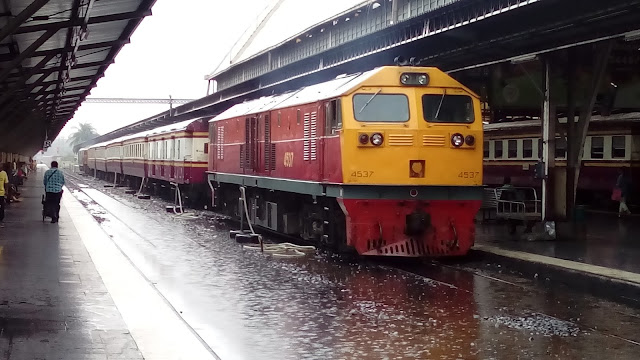
No bullet trains in Thailand - the State Railways of Thailand operates comfortable, old fashioned trains of the sort novelists love to write about!

The main hall at Bangkok's Hua Lamphong Railway Station, first opened in 1916. The station has a separate counter for foreigners where staff speak English. The station is accessible by Bangkok's subway system. 
Regal Ayutthaya

Ayutthuya is a historic Siamese (Thai) city. It was the capital of the Kingdom of Ayutthuya (1351-1767). Despite almost constant warring with Burma (now known as Myanmar), the Ayutthuya Kingdom was a regional economic powerhouse. The city was home to a multitude of foreign traders, some from as far as Europe.

As the train pulled into Ayutthuya, I only had a vague idea of my action plan. I knew I must see the magnificent temples and ruins sprinkled across the city but I had no idea how to get to them. As I was alone I decided would 'improvise' as I went along: no need for any detailed Grand Master Plan!

A view of Ayutthaya Railway Station. It was raining when my train arrived and the middle platforms had no canopies protecting passengers from the rain or sun. 
The adventure takes shape

At the Ayutthuya train station, a suburban size station with perhaps four lines running through, I paused to gather my thoughts. Luckily, there was a tourist guide map posted at the station. After taking a look at the map, I realized most of the sites were concentrated in one area of the city across the river. The map was not drawn to scale so I couldn't gauge how far the ruins were from the railway station. Nonetheless, I decided I had time and could walk the distance.

A self-guided walking tour meant I must diplomatically extricate myself from the clutches of the umpteen 'Tuk Tuk' drivers offering their services as expert guides. Their sales pitch included statements intended to create fear such as, "The temples are many kilometers away from here" and "the river is very wide, cannot cross!"

Being the Intrepid Immortal Explorer I ignored the scare tactics and decided to try my luck anyway.

I ventured out of the station – there is only one direction to exit the station. Upon leaving the station, I walked towards the area where Thai food stalls - of the usual sort found all across Thailand - were located and found myself at the mouth of a small street.

With the railway station behind me there was only one way to go: forward!

A few hundred meters and several small hotels later I came across a sign for a boat crossing across the river.

The jetty for the boat across the river. 
Across the river and into Ayutthaya's deserted streets

After paying my five Baht - about USD 0.15 - I boarded a small boat at a wooden jetty to cross the river. Accompanying me on the boat were a few other travelers along with some locals going about their daily business. Based on my cursory reading of the city map at the train station (I was distracted by the tuk tuk drivers harassing me) after crossing the river I must continue to head 'forward' until 'a visible sign' indicating otherwise.

So, once on the other bank of the river, I headed 'forward' hoping for a sign it was the right direction.

As the glaring Thai sun burnt a hole in the top of my head, I started doubting my initial bravado thinking, "What an idiot?! Wouldn't it have been easier (and wiser) to have hired a tuk tuk driver, see the sights and not walk around like a crazy 'farangi' in a foreign land?!" Another part of me said, "Relax. The only way to see a country is on foot. I have time. Walking is the best way to experience a foreign land. If I get lost I can always pay an extortionate fee to the next tuk tuk driver and get myself back to the Ayuttuya Railway station. Besides, no one ever got good photographs sitting in the back of a tuk tuk!"

In an age before Google Maps led pedestrians to destinations, there were pagodas! The tall structures act as landmarks for fearless travelers.

Pagodas from heaven

Then it happened, as if I had stolen a glance at heaven I saw the pinnacle of a stupa! After spotting the pagoda, all doubts quickly receded and the Intrepid Immortal Explorer in me was revived!


Based on my precise calculations, the stupa which was hidden behind buildings, was located up ahead (forward, forward, it's always forward!) and slightly to the left. So I walked in a slightly forward leftish direction towards the pagoda.

Success was not long in coming.

Behold Ayutthaya's glory?

This is it? No, it couldn't be. Yes, it's ornate and historical … but, it's one temple, slightly small and certainly not as majestic as I expected in the grand, wealthy, regal capital city of Ayutthaya!


Two views of the first historical structure I came across. It was outside of the main excavation site. 
I soon realized this temple was an appetizer. It is a secondary site and not a part of Ayutthaya's major excavations. Despite the disappointment I took as many photographs as possible. After all, if I didn't find the city's major sites I should at the very least have something to show for my trip?!

Hope keeps humanity alive. After tasting minor success, major success must be around the corner! So onwards I went. In the only direction I know: forward.

Those who don't believe in an Omniscient Power should enlist as soldiers to fight in the latest global war. (There are no atheists in trenches.) If the thought of death in uniform doesn't quite take your fancy, then the next best thing is a walk around the deserted streets of Ayutthuya with neither an online nor a paper map. Either experience is enough to make a person believer!

Then providence smiled for me once more.

I saw another, this time more imposing, pagoda like structure in the distance! Again, my choice was clear: forward, forward towards the pagoda.

Behold Ayutthaya's glory part II!

As I got closer to the site I noticed a few visitors milling around the area. There were ruins spread out over a large area. The main structure was undergoing restoration. I was encouraged by the sight of a ticket office collecting an entrance fee from all visitors. The ticketing booth was a sign I was getting closer to the main event.

I paid my fee, went inside and explored. The overcast lighting was not supportive for photography but I went crazy anyway. This might be the best set of ruins I come across today. So I explored every ruin, pagoda, broken Buddha sculpture and anything else I could find at the site.

At the time I was unaware this site was Wat Ratchaburana, one of Ayutthaya's main Buddhist temples. After I climbed atop the main structure I observed multiple pagoda and stupa like structures to my left. My 'go it alone and leave the tuk tuk behind' decision was being vindicated with each passing minute!


Several views of a major excavation in Ayutthaya from the heyday of the city as capital of a flourishing Buddhist Kingdom. It is alleged the heads of many Buddha statues were decapitated by Burmese invaders when they ransacked the city in the eighteenth century.
After completing my methodical review of Wat Ratchaburana, I scurried across the road to the area of the multiple pagodas. It was an enclosed location and I couldn't find the entrance. There weren't many people around. 

Success comes to those who sweat (and walk the lonely road)!

After walking a little farther the whole world suddenly seemed to open. There were tourist buses, traders manning little stalls and tourists everywhere.

This has to be the place. The average tourist is not bussed to any old historical attraction – only significant ones. Tourists are on a busy schedule, taking 'selfies' at multiple locations requires using time efficiently!

I bought my entrance ticket and proceeded inside.

The temples were amazing. Surely, Ayutthaya's temples will give Angkor Wat a run for its money. (I recently learned Angkor Wat once was part of the Siamese Empire and, in case Cambodians forget the fact, there exists a scale model of Angkor's temple complex inside the Bangkok palace.)


Inside the Ayutthaya Historical Park: scene of the majority of remains associated with the Kingdom of Ayutthaya.
A short while later, I found myself staring at the famous 'Buddha Head in Tree Roots' and several other 'vintage' Ayutthaya structures. It is easy to understand why the ruins enclosed inside the Ayutthaya Historical Park were designated a UNESCO World Heritage Site in 1991.


The Buddha Head in Tree Roots, a landmark Ayutthaya attraction.
By the time I started my walk back to the railway station I was a content traveler.

To experience a foreign land travel like a peasant not a prince

At the railway station I bought my ticket and waited for the train. Only this time I decided to travel in a non-air conditioned, third class carriage without a reserved seat.  After my success in navigating Ayutthaya, traveling 'like a local' seemed the most fitting way to cap my day.

I was not mistaken.


Once the train pulled into Ayutthaya Station I scrambled aboard the Third Class carriage. It was not easy finding a seat but I squeezed onto one across from a Thai gentleman who epitomized an ageing rock star of yesteryear. He had the tattoos and pony tail to prove it. On the other side of the aisle was a mother with her young five-six year old daughter.

The rest of the carriage was crammed with all variety of goods and people. One woman seemed to be travelling to Bangkok with enough items to fill up an entire shop. (I suspect she was traveling to the big city to do exactly that, i.e. set up shop.) Occasionally, a man or woman would walk through the carriage offering food for sale. The carriage was a veritable Thai village on wheels!

Over the course of the ninety minute journey I got a few nice smiles from the little girl across the aisle – enough to liven up an otherwise lethargic journey. Though I didn't have the nerve to ask the rock star for his autograph!

A happy ending!

Despite the poor light conditions for photography, my Ayutthaya experience was thoroughly enjoyable. A return visit is definitely on the cards. Although on my next visit I may hire a bicycle to help me move around. The roads are not busy and the city is compact enough to conveniently cycle between the main sights.

For visitors to Bangkok, Ayutthaya is an easy and convenient day trip out of the city's urban sprawl. Taken holistically, Ayutthaya is a worthwhile escape especially as it gives a glimpse into 'non-Bangkok' Thailand. Bangkok is another country altogether ….
__________________
Imran is a Singapore based Tour Guide with a special interest in arts and history. Imran has lived and worked in several countries in his career as an international banker. He enjoys traveling, especially by train, to feed his curiosity about the world and nurture his interest in photography. Imran can be contacted at imran.ahmed.sg@gmail.com. Follow Imran on twitter at @grandmoofti and Instragram at imranahmedsg.

Monday, 4 March 2013

Reflections from Pakistan X: Lahore’s Mogul heritage


"His eyes might there command whatever stood
City of old or modern fame, the seat
Of mightiest empire, from the destined walls
Of Cambalu, seat of Cathian Can,
And Samarcand by Oxus, Temir's throne,
To Paquin of Sinaen Kings, and thence
To Agra and Lahore of Great Mogul..."

John Milton, Paradise Lost.

Lahore is more than just the city of my mother's birth. It is one city in Pakistan which inherited a significant heritage from the Mogul Empire. The numbers of major and minor Mogul monuments in the city are counted by the dozens. The major architectural sites include the Shalimar Gardens, the Lahore Fort with its Sheesh Mahal (Palace of Mirrors) and Emperor Jahangir's tomb.

From the time that Central Asian warlord, Babur, found his way to Delhi's throne in 1526, it was some years before Lahore got the attention it deserved. Lahore perhaps first came into prominence during Emperor Jahangir's rule (1605-27). Jahangir was the fourth king and son of the Mogul-e-Azam, Akbar.

Emperor Jahangir, the fourth Mogul Emperor and son of Mogul-e-Azam Akbar
One of the lesser known Moguls, perhaps Jahangir's wisest act of state was not to interfere too much with the Empire's machinery he inherited from his father, Akbar. In 1605, the year Jahangir ascended the throne, the Mogul Empire was well established although still expanding its borders geographically. The treasury's coffers were well supplied with revenue from taxation and tributes received from vassal states.

A financially stable empire permitted Jahangir to pursue his interests in arts and culture – and remain inebriated for most of his waking hours! Consequently, while Jahangir's wife (or mother) was running affairs of state Jahangir remained busy enjoying nature, hunting and patronizing the arts.

Possibly due to his love of nature, Jahangir travelled frequently from the Empire's administrative capital in Delhi to Srinagar, Kashmir. Fortunately for Lahoris, the most convenient route to the Kashmiri city went through Lahore. Consequently, Lahore received a fair amount of time and attention from the Jahangir.  

In 1606, some of the King's time was spent constructing 'Hiran Minar' or 'The Deer / Antelope Minaret.' Hiran Minar is a pavilion set in a body of water. The site is dedicated to honouring the memory of the Emperor's pet antelope, Mansraj. To Lahoris, Hiran Minar is just another picnic spot.

Hiran Minar: located on the outskirts of Lahore


In 1627, while en route to Kashmir, Jahangir died at the age of 57. Fittingly, Jahangir is buried in Lahore. In Mogul style, Jahangir's mausoleum is surrounded by lavish gardens creating another recreation spot for Lahoris and tourists alike.

The Mogul fascination with Lahore did not die with Jahangir. It lasted until near the end of the empire. The last of the 'Great Moguls,' Aurangzeb, built the famous Badshahi Masjid – an icon and landmark for modern Lahore. The mosque can accommodate 100,000 worshippers in its prayer halls and courtyard.

Lahore is neither Pakistan's capital nor its commercial hub. However, the capital of Punjab province has rightfully staked a claim as the country's cultural center. One hopes the present generation of Lahoris will do justice to the deeds of their ancestors.
__________________
Imran is a business and management consultant. Through his work at Deodar Advisors and the Deodar Diagnostic, Imran improves profits of businesses operating in Singapore and the region. He can be reached at imran@deodaradvisors.com